Gangs Wars: Pixel Shooter RP
- 4.4
- Rating
- 10.00M
- Installs
- Free
- Price

 Analysis by App-foxy
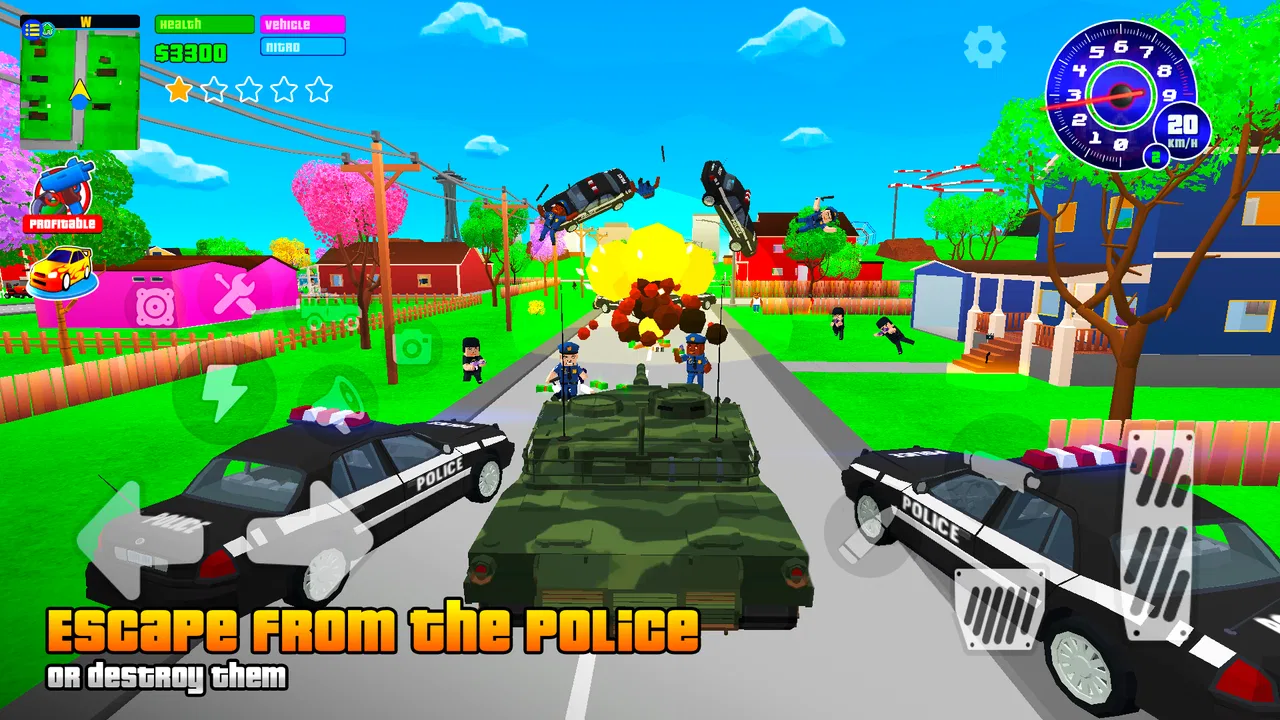
Gangs Wars: Pixel Shooter RP is the kind of action game I open when I want a quick crime-themed sandbox rather than a polished, serious crime drama. Its blocky visual style keeps the mood playful, while the first-person shooting and open-world setting give it enough room for improvised trouble. My overall view is simple: this is a surprisingly accessible offline gangster game, but it is best enjoyed as a loose playground, not as a deeply structured role-playing experience.
I found the appeal strongest in the freedom to decide what kind of session I wanted. I could treat it as a straightforward shooter, wander around looking for trouble, or create a small personal scenario and see how long I could keep it going. That flexibility matters because the game does not rely on one carefully scripted path to stay interesting. It gives me a setting, weapons, criminal themes and room to experiment, then asks me to make my own fun.
Why the pixel crime sandbox works
The game comes from playducky.com and sits firmly in the action game category. Its mature presentation is aimed at players aged 17 and above, which makes sense for the gangster setting and gun-focused gameplay. The pixel-art approach is important here: it softens the violence visually and gives the city a deliberately rough, game-like personality instead of trying to imitate a realistic console shooter.
You May Also Like

 Blood Strike: 2.5 Anniversary
Blood Strike’s Loadouts Turn Every Drop Into a Tactical Gamble
A close look at Blood Strike’s custom loadouts: how fast access to signature weapons reshapes its battle royale rhythm, rewards preparation, and narrows the gap between fights.

 Pandora - Music & Podcasts
Pandora’s Music Is Easy to Start, but Harder to Recover
Pandora’s strength is its low-effort path from a seed to a station. Its weak spot is how much confidence it asks you to place in connection, setup, and quiet recovery.

 8 Ball Pool
 Is Built on Rivalries, Rematches, and Routine
A close look at the rivalries, rematches, shared routines, and unanswered safety questions that turn a quick pool match into a persistent mobile community.

 Samsung Music
’s Quiet Strength Is Playing What You Already Own
Its reach comes less from spectacle than from dependable access to a personal library. That simplicity is both the app’s strongest retention engine and its ceiling.

 AccuWeather: Weather Radar
AccuWeather Review: A Quick, Clear Forecast for Everyday Decisions
For everyday plans, the best forecast is the one you can understand quickly. AccuWeather makes rain timing, radar, and local conditions easy to act on, with a few trade-offs.

 Hill Climb Racing
Why Hill Climb Racing Still Turns Crashes Into One More Run
A tiny car, a bumpy hill and one more upgrade: Hill Climb Racing keeps resurfacing because its simple chaos makes every near-miss feel personal.
More From Our News Desk



That style also helps the game feel approachable on a wider range of Android devices. It supports Android 7.0 or later, and the modest-looking presentation means I never approach it expecting the visual detail or cinematic atmosphere of a large premium production. In exchange, the game can focus more on movement, quick encounters and the pleasure of causing controlled chaos.
The first-person viewpoint gives ordinary actions more immediacy. Walking through the environment, aiming at a nearby target and reacting to a sudden confrontation all feel more direct than they would from a distant camera. At the same time, the pixel visuals make mistakes easier to forgive. When a situation becomes messy, I read it as part of the sandbox rather than as a failure of realism.
The offline angle is one of the most practical strengths. I can play during a commute, while waiting somewhere, or in a place where I do not want to depend on a stable connection. That makes it different from many action games that treat online access as part of their identity. Here, the game is more suitable for short personal sessions, and I do not have to coordinate with other players before starting.
A useful way to approach it is to set a small objective before entering the world. I might decide to explore a particular area, create a chase, test how long I can survive after starting trouble, or simply move around until an interesting encounter develops. This self-directed approach is more rewarding than expecting a tightly paced campaign to constantly tell me what matters next.
The crime-scheduling idea adds another layer to that freedom. Rather than seeing every activity as a random interruption, I can think of a session as a plan: prepare, move into position, cause the disturbance and then deal with the consequences. Even when the game remains simple, this mindset makes the open world feel more purposeful. It turns a collection of actions into a little story that I have created myself.
One of my favorite ways to use that structure is to play in two phases. First, I explore without immediately firing, learning the shape of the area and noticing where I can move. Then I begin the criminal action and use that familiarity to choose an escape direction. This is more satisfying than rushing into every encounter, because the environment starts to feel like something I can use rather than just a background.
The pixel presentation also makes experimentation less intimidating. I am more willing to try an unusual route, start a fight at an inconvenient moment or test an idea that would feel frustrating in a realistic shooter. The game encourages trial and error because its world is built around playful disruption. That quality is especially useful for younger-looking players who enjoy action but do not want a grim, visually intense experience; the mature rating still means families should make their own age decision.
Another strength is the low commitment of each session. I do not need to reserve a long evening to get something from it. A short visit can be spent exploring or creating one chaotic encounter, while a longer session lets me build a more elaborate sequence of events. This makes it a reasonable companion game for people who prefer open-ended mobile play over long story missions.
Its popularity suggests that this formula has found a substantial audience: the game has passed 10 million installs and holds a 4.4 average from around 80 thousand ratings. Those numbers do not prove that every player will enjoy it, but they do show that the combination of pixel visuals, gangster action and sandbox freedom has broad appeal. I can understand why, because the basic idea is easy to grasp within minutes.
Compared with a conventional mission-based shooter, the game gives me less pressure to perform perfectly. A traditional action title may reward precise progress through a fixed sequence, while this one is more about what happens when I combine movement, shooting and criminal scenarios in an open setting. If I want a clear narrative arc, that difference may feel like a weakness. If I want a toy box for improvised action, it is the main reason to stay.
Compared with a large open-world crime game, the trade-off is even clearer. This title is lighter, more compact in spirit and easier to pick up, but it does not aim for the same depth of dialogue, character development or realistic world simulation. I would choose it for quick offline entertainment and choose a larger alternative when I wanted a richer story, more detailed driving or a world designed for long-term immersion.
Small decisions that make sessions better
The first practical tip I would give a new player is not to treat every encounter as a race toward maximum destruction. Starting with observation gives me more control. I can identify a route, decide where I want the action to happen and avoid turning the opening moments into random movement. That simple pause makes the sandbox feel more tactical, even though the game remains accessible.
I also recommend separating exploration from experimentation. On one visit, I can focus on learning the environment and understanding how the world feels. On another, I can deliberately test a risky idea. Mixing both goals at once often makes it harder to tell whether a failed attempt came from poor planning or from not knowing the area.
A third useful habit is to invent a stopping point before beginning. For example, I might finish after completing one planned crime, escaping a difficult situation or discovering a new route. Open-ended games can become repetitive when I continue without a personal goal. Giving each session a small ending keeps the chaos entertaining instead of turning it into aimless wandering.
These habits reveal a strength that is easy to miss in a short store description: the game works best when I supply a little structure myself. It is not just about shooting at whatever appears. It can become a lightweight role-playing exercise if I decide who my character is, what they are attempting and when the story ends. That is not the same as having a complex role-playing system, but it gives the sandbox more staying power.
Where the experience loses momentum
The same freedom that makes the game inviting can also make it feel thin. When I want a strong reason to continue, an authored mission chain or a carefully developed cast, the open-ended format does not always provide enough direction by itself. The game is more convincing as a playground than as a complete gangster saga, and expecting the latter can lead to disappointment.
The pixel style is another matter of taste. I enjoy its clarity and playful tone, but players looking for realistic weapons, believable city detail or an intense cinematic atmosphere may find it too basic. The visual design is not merely a technical compromise; it defines the personality of the whole experience. If that style does not appeal to you, the action underneath may not be enough to change your mind.
There is also a difference between offline convenience and social depth. Playing without an internet connection is excellent for private, flexible sessions, but it means the entertainment depends heavily on my own willingness to create scenarios. Someone who wants competitive matches, cooperative planning or a constantly changing online world should look elsewhere in the action category.
The free entry point helps remove the biggest barrier to trying it, but the presence of optional purchases is worth keeping in mind. Individual in-app items range from $0.99 to $64.99, so I would approach spending carefully and decide in advance whether I am happy with the free experience. For me, the sensible method is to play long enough to understand the core loop before considering any purchase. A sandbox should first prove that its basic play is enjoyable without extra spending.
The game is currently listed as version 0.26.18. I see that as a reminder to judge it for what it offers now rather than expecting the completeness of a long-established premium release. Players who enjoy watching a game develop may be comfortable with that feeling, while those who want a perfectly settled and highly polished package may prefer a more mature alternative.
Controls are especially important in a first-person mobile shooter. I would not recommend deciding whether the game suits you after only a few seconds of movement. Give yourself enough time to adjust to aiming, turning and reacting in a crowded situation. The open-world format can feel enjoyable once those actions become familiar, but awkward control habits can make every encounter seem harder than it should.
Another limitation is that the game’s broad freedom can blur the difference between a meaningful plan and repeated chaos. I enjoy creating my own scenarios, but I still need variety in what I ask from the world. If I use the same approach every time, the novelty fades. This is why I think the game works better in short bursts than as an all-day replacement for a deeper open-world title.
Who should install it?
I would recommend it to players who like offline open-world action, pixel graphics and self-directed mayhem. It is a good fit for someone who wants to launch a game quickly, create a little criminal scenario and stop whenever real life demands attention. It also suits players who prefer a forgiving, stylized presentation to a realistic and heavily dramatic one.
A realistic everyday use case is a short waiting period with no dependable connection. I can start a session, explore for a few minutes, plan a small crime, deal with the resulting action and close the game without needing another player or a long uninterrupted campaign. That convenience is more valuable than it sounds, especially for a mobile game intended to fit around the rest of the day.
I would be more cautious about recommending it to someone who mainly plays for story. If your favorite part of a gangster game is following memorable characters through carefully written missions, this may feel too loose. The same applies to players who want realistic driving, advanced role-playing choices or a competitive multiplayer community. A traditional campaign shooter or a larger crime sandbox would be a better match for those priorities.
The mature rating should also be taken seriously. The pixel look may appear less intense than realistic violence, but the themes remain centered on gangs, crime and shooting. I would not treat the simplified graphics as a reason to ignore the intended age guidance.
For new players, my recommendation is to begin without spending money. Learn whether the movement, shooting and open-ended structure fit your taste first. If you enjoy inventing scenarios and returning for short sessions, the free version has a fair chance of keeping you interested. If you need constant progression or a strong narrative hook, optional purchases are unlikely to solve the underlying mismatch.
My final take
Gangs Wars: Pixel Shooter RP succeeds because it understands the appeal of a simple mobile crime sandbox. It gives me an immediately recognizable setting, first-person action, pixel visuals and the freedom to arrange my own trouble. The best moments come from planning a small situation and watching it develop, not from following a grand, carefully scripted story.
Its weaknesses are closely connected to that design. The world can feel less substantial when I stop supplying my own goals, and the lightweight presentation will not satisfy anyone searching for realism or cinematic depth. The optional purchases also deserve restraint, particularly because the upper end of the item range is much higher than the cost of simply trying the game for free.
Still, I think the balance is worthwhile for the right player. The game is free, supports offline play, runs on Android 7.0 and later, and has attracted more than 10 million installs. Its developer, playducky.com, has built something that is easy to understand but flexible enough for personal experiments. I would recommend it to a friend who wants quick, stylized gangster action and is happy to make their own objectives.
My verdict is favorable with a clear condition: choose this for an improvised pixel playground, not a full-scale crime epic. If that distinction matches what you want, the game can turn short mobile sessions into entertaining little stories of planning, panic and escape. If you need a deeper campaign, realistic simulation or multiplayer competition, another action game will serve you better.
FAQs for Gangs Wars: Pixel Shooter RP
01What is Gangs Wars: Pixel Shooter RP?
Gangs Wars: Pixel Shooter RP is a pixel-styled multiplayer action game that combines shooting, open-world exploration, gang activities, and role-playing elements. Players can move around a city, interact with other users, complete missions, use different weapons, and build their own character. The experience is designed around online interaction, so gameplay may vary depending on the activity of the server and the behavior of other players.
02Can I play Gangs Wars: Pixel Shooter RP offline?
The game is primarily designed for online play because its role-playing, multiplayer, and gang-related features depend on communication with other players and access to shared game servers. You should expect to need a stable internet connection for the main experience. Offline access, if available for limited menus or practice content, should not be considered a replacement for the full multiplayer gameplay.
03Is Gangs Wars: Pixel Shooter RP suitable for children?
Parents should review the game’s official age rating before allowing children to download it. Although the visuals use a colorful pixel-art style, the gameplay can include firearms, gang conflicts, combat, crime-themed missions, and interaction with strangers through online features. Chat or multiplayer communication may also expose younger users to inappropriate language or behavior, so parental supervision and device privacy settings are recommended.
04Does Gangs Wars: Pixel Shooter RP include in-app purchases or advertisements?
The availability of advertisements, optional purchases, or other monetization features can depend on the version of the game, platform, and region. Before downloading, check the Google Play Store or Apple App Store listing for current pricing information and purchase details. If the game offers paid items, review whether they affect cosmetics, progression, weapons, or convenience, and consider enabling purchase restrictions on shared devices.
05What device and permissions are required to play the game?
Gangs Wars: Pixel Shooter RP requires a compatible Android or iOS device with enough free storage for installation and updates. Because it is an online multiplayer game, reliable Wi-Fi or mobile data is also important. The exact operating-system requirements may change with future updates, so consult the official store page before installing. Review requested permissions carefully and avoid downloading modified versions from unofficial websites.
Pros
- Retro pixel-art style gives the game a distinctive visual identity.
- Role-play elements add variety beyond standard shooting matches.
- Quick rounds make it easy to play during short breaks.
- Different weapons encourage experimentation with play styles.
- The urban gang theme creates a memorable game atmosphere.
Cons
- Pixel visuals may feel dated to players who prefer realistic graphics.
- Controls can take time to master on smaller phone screens.
- Matches may become repetitive without frequent content updates.
- Online play can be frustrating when connections are unstable.
- The gang-focused theme may not appeal to younger players or all audiences.

Gangs Wars: Pixel Shooter RP
Gallery